
Ganesh Sthapana Vidhi 2026
Step-by-Step Ganpati Sthapana Procedure, Material Checklist & Auspicious Muhurats
Quick Facts: Ganesh Chaturthi Sthapana 2026
Monday, September 14, 2026
11:02 AM to 01:31 PM (IST)
Lord Ganesha (Ganpati)
Prana Pratishtha, Snana & Naivedya
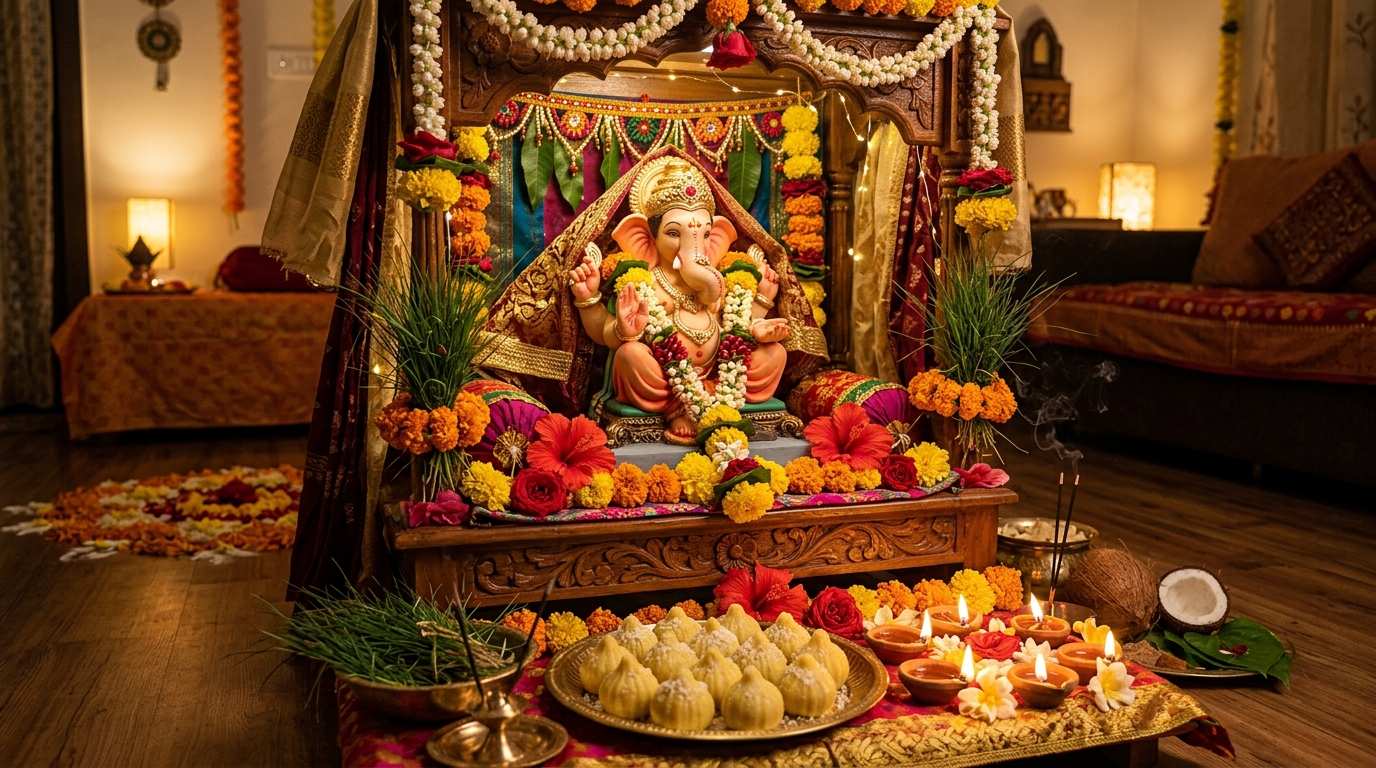
Ganesh Chaturthi Sthapana 2026 Shubh Muhurat
In 2026, the most auspicious time to perform Ganesh Sthapana and Puja is on Monday, September 14, 2026, between 11:02 AM and 01:31 PM (IST). This 2-hour and 29-minute window corresponds to the traditional Madhyahna (midday) period, which is the most propitious timing for welcoming Lord Ganesha. Performing the installation within these hours maximizes spiritual alignment and positive cosmic energy according to the Marathi Panchang.
Explore September Calendar: Since Ganesh Chaturthi is celebrated in September, check the full Kalnirnay September 2026 Calendar for daily tithi details and complete festival dates.
11:02 AM to 01:31 PM Duration: 2 Hours and 29 Minutes
Ganpati Puja Samagri Checklist (पूजा साहित्य)
To perform a complete and authentic Ganesh Puja, you require essential elements like a Shadu clay idol, red Hibiscus flowers, Durva grass, and steamed Modaks. Having these materials ready before the Muhurat begins ensures a smooth and focused ritual. Below is the complete checklist of traditional puja items along with their scriptural and spiritual significance:
| Item Name (English) | Marathi / Hindi Name | Significance |
|---|---|---|
| Ganesha Clay Idol | शाडू मातीची मूर्ती (पार्थिव गणपती) | Eco-friendly clay idol representing Earth element. |
| Red Hibiscus Flowers | जास्वंद फूल (लाल फूल) | Ganesha’s favorite flower representing energy. |
| Durva Grass Leaves | दूर्वा (21 कोंब) | Three-bladed grass representing peace and cooling energy. |
| Modak Sweet | मोदक (उकडीचे किंवा खव्याचे) | Ganesha’s favorite sweet representing inner bliss and wisdom. |
| Sacred Thread | जानवे (यज्ञोपवीत) | Offered around the left shoulder of Ganesha’s idol. |
| Sandalwood Paste | रक्त चंदन / अष्टगंध | Fragrant sandalwood paste applied as Tilak. |
| Panchamrit | पंचामृत (दूध, दही, तूप, मध, साखर) | Nectar mixture used for symbolic bath. |
| Betel Nuts & Leaves | सुपारी और पान के पत्ते | Used as representations of planetary gods. |
Step-by-Step Sthapana Procedure (पूजा मांडणी व विधि)
The traditional Ganesh Sthapana involves cleaning the altar, placing the clay idol, inviting the deity’s presence (Pranapratishtha), and offering flowers, Durva, and Modaks. By following ten structured steps, you can perform this sacred ritual yourself at home without requiring a priest. Here is the step-by-step procedure to welcome and install Lord Ganesha correctly:
- Step 1: Clean and Prepare: Clean the entire house and decorate the wooden altar (Makhar/Chowki) with flowers, leaves, and light strings. Draw a Rangoli at the entrance.
- Step 2: Altar Setup: Lay a clean yellow or red cotton cloth over the wooden Chowki. Spread a cup of raw rice grains in the center of the platform.
- Step 3: Bringing the Idol: Cover the Ganesha idol’s face with a clean handkerchief while carrying Him inside. Gently place the Ganesha idol on top of the spread rice grains. Unveil the face while chanting “Ganpati Bappa Morya!”.
- Step 4: Kalash Installation: Place a copper Kalash filled with pure water next to the Ganesha idol. Place 5 mango leaves around the rim and top it with a coconut. Draw a swastika symbol in kumkum on the Kalash.
- Step 5: Pranapratishtha (Invocation): Invoke the divine spirit into the clay idol. Touch Ganesha’s heart symbolically with a durva grass leaf or flower, close your eyes, and chant the Prana Pratishtha mantra (see below).
- Step 6: Bathing (Snana): Bathe the idol symbolically by sprinkling drops of Panchamrit and pure water over Ganesha using a flower. Dry gently.
- Step 7: Vestments & Sacred Thread: Offer the red/yellow sacred thread (Janve) over Ganesha’s left shoulder, crossing under the right arm. Decorate Him with garlands and apply Ashtagandha Tilak on Ganesha’s forehead.
- Step 8: Flower offerings: Offer 21 stems of three-bladed Durva grass and Ganesha’s favorite red Hibiscus flower.
- Step 9: Naivedya (Food offering): Place a plate with 21 Modaks (steamed modaks are best) in front of the altar. Offer dry fruits, betel nut, and fruits. Pour pure water around the food plate in a circular direction.
- Step 10: Aarti & camphor: Light the camphor (kapur) lamp and wave it while singing the traditional Ganesha Aarti (*Sukharta Dukharta*). Pray for peace, wisdom, and obstacle removal.
What Most People Get Wrong About Ganesh Sthapana
Many households make minor mistakes during Ganesh Sthapana by choosing the wrong idol material, placing multiple Ganeshas, or ignoring directional rules. Avoiding these common errors maintains the spiritual purity of the ritual and ensures positive vibrations. Here are the key misconceptions corrected by practitioner insights:
- Using Plaster of Paris (PoP) Idols: Worshippers often select PoP idols for their light weight and colors. However, scriptures prescribe Shadu clay (Earth element or Prithvi Tattva) because natural clay grounds and absorbs spiritual energies, besides being eco-friendly and dissolving easily during immersion.
- Placing Multiple Ganesha Idols: Keeping two or more Ganesha idols in the same puja altar is astrologically discouraged. It is believed that multiple Ganeshas create conflicting energy waves, reducing the focus and peace of the home.
- Facing the Deity South: Placing the Ganesha altar facing South is a major error. The deity’s idol should face East or West. The devotee should face either East (for spiritual growth) or North (for wealth and prosperity) during the puja.
- Puja During Rahu Kaal: Many assume that any time on Ganesh Chaturthi is suitable for the sthapana. Performing sthapana during Rahu Kaal is inauspicious. Always avoid the Rahu Kaal window (which you can check on our daily panchang page) when scheduling your puja.
Situational Decision Framework for Ganesh Puja
Your approach to Ganesh Sthapana should adapt based on your specific situation, such as missing the auspicious Muhurat or setting up puja in a small apartment. The table below outlines realistic scenarios, correct actions, and spiritual outcomes to guide your decisions:
| If Your Situation Is… | The Recommended Action Is… | The Spiritual & Practical Outcome Is… |
|---|---|---|
| You missed the midday Madhyahna Muhurat window (11:02 AM – 01:31 PM). | Perform the Sthapana during the evening Pradosh Kaal (06:15 PM to 08:30 PM) or check the next auspicious hourly Choghadiya. Strictly avoid Rahu Kaal. | Ritual compliance is maintained without performing the installation during inauspicious solar alignments. |
| You live in a small, modern apartment with limited room for a large altar. | Use a compact wooden Chowki facing East. Choose a small 5-to-9 inch Shadu clay Ganesha and a miniature copper Kalash. | Saves space while ensuring full compliance with spatial direction and Vedic altar rules. |
| You cannot find fresh Durva grass or red Hibiscus flowers locally. | Offer fresh green grass blades or any red flowers. If unavailable, offer Akshata (rice grains mixed with turmeric and kumkum) as a symbolic substitute. | Deity respects the devotion (Bhaav) over the physical item. The worship remains complete and accepted. |
Key Vedic Terms & Meanings in Ganesh Sthapana
To understand the deeper meaning of Ganesh Puja, it is essential to learn terms like Madhyahna, Prana Pratishtha, and Durva. These elements are not just ritual steps; they represent astronomical alignments and energy channels. Below are their semantic definitions and roles in the puja:
- Madhyahna Kaal: The specific time of day when the Sun is at the meridian (midday). According to legend, Lord Ganesha was born at midday, so performing sthapana during these hours aligns the ritual with peak solar energy.
- Prana Pratishtha: A sacred rite that invites the cosmic life force (Prana) of Lord Ganesha to occupy the clay idol. This transforms a physical object into a living channel of divine communication.
- Durva Grass: A three-bladed wild grass that represents the three gunas (Sattva, Rajas, Tamas). Offering 21 stems of Durva cools the hot cosmic energy of Ganesha and brings peace to the worshipper’s mind.
- Modak: A steamed sweet representing spiritual wisdom (Jnana). The outer thin layer represents the physical body, while the sweet coconut-jaggery stuffing represents the sweet, eternal soul inside.
Important Sthapana Mantras
The key mantras for Ganesh Sthapana include the Pranapratishtha Mantra to invoke life, the Bathing Mantra, and the Naivedya Mantra to offer food. Chanting these Sanskrit verses with devotion infuses positive vibrations into the home. Below are the essential mantras in Devanagari script, English transliterations, and detailed meanings:
ॐ अस्यै प्राणाः प्रतिष्ठन्तु अस्यै प्राणाः क्षरन्तु च।
अस्यै देवत्वमर्चायै मामहेति च कश्चन॥
“Om Asyai Pranah Pratishthantu Asyai Pranah Ksharantu Cha,
Asyai Devatvamarchayai Mamaheti Cha Kaschana.”
Meaning: May the vital life-force enter this clay form; may His senses be established. May this idol carry the supreme divine spirit of Lord Ganesha for our prayers.
ॐ गं गणपतये नमः।
गंगाजलस्नानं समर्पयामि, पंचामृतस्नानं समर्पयामि॥
“Om Gam Ganapataye Namah,
Gangajalashnanam Samarpayami, Panchamritashnanam Samarpayami.”
Meaning: Salutations to Lord Ganesha (Gam). I symbolically offer holy Ganges water and nectar-rich Panchamrit baths to welcome Him.
ॐ प्राणाय स्वाहा, ॐ अपानाय स्वाहा, ॐ व्यानाय स्वाहा,
ॐ उदानाय स्वाहा, ॐ समानाय स्वाहा, नैवेद्यं निवेदयामि॥
“Om Pranaya Swaha, Om Apanaya Swaha, Om Vyanaya Swaha,
Om Udanaya Swaha, Om Samanaya Swaha, Naivedyam Nivedayami.”
Meaning: I make these sacred modak food offerings to the five vital airs (Prana, Apana, Vyana, Udana, Samana) of Lord Ganesha. Please accept our humble meal.
Ganesh Chaturthi Sthapana 2026 FAQs
Find answers to the most frequently asked questions about Ganpati idol installation, Muhurats, and traditional rituals.
Ganesh Chaturthi in 2026 will be celebrated on Monday, September 14, 2026. This marks the beginning of the auspicious 10-day Ganeshotsav festival, culminating with Anant Chaturdashi (Visarjan) on September 24, 2026.
The most auspicious time to perform Ganesh Sthapana and Puja is during the Madhyahna (midday) window from 11:02 AM to 01:31 PM on Monday, September 14, 2026, which is believed to align with Ganesha’s cosmic birth timing.
Shadu clay is a natural element of the earth (Prithvi Tattva). It holds and retains the positive vibrations generated during Sanskrit chants much better than chemical PoP. It also dissolves cleanly in water during Visarjan without polluting local lakes and rivers.
The Lord Ganesha idol should face East or West. Avoid placing the idol facing South. For the worshipper, facing East or North during the sthapana and daily aarti/prarthana is highly recommended to receive positive planetary energy.