
Diwali Lakshmi Pujan 2026
Detailed Puja Vidhi, Step-by-Step Instructions & Auspicious Muhurat Timings
Quick Facts: Diwali Lakshmi Pujan 2026
Sunday, November 8, 2026
06:15 PM to 08:00 PM (Sthir Lagna)
Goddess Lakshmi & Lord Ganesha
Coriander Seeds, Lahya-Batashas & Coins
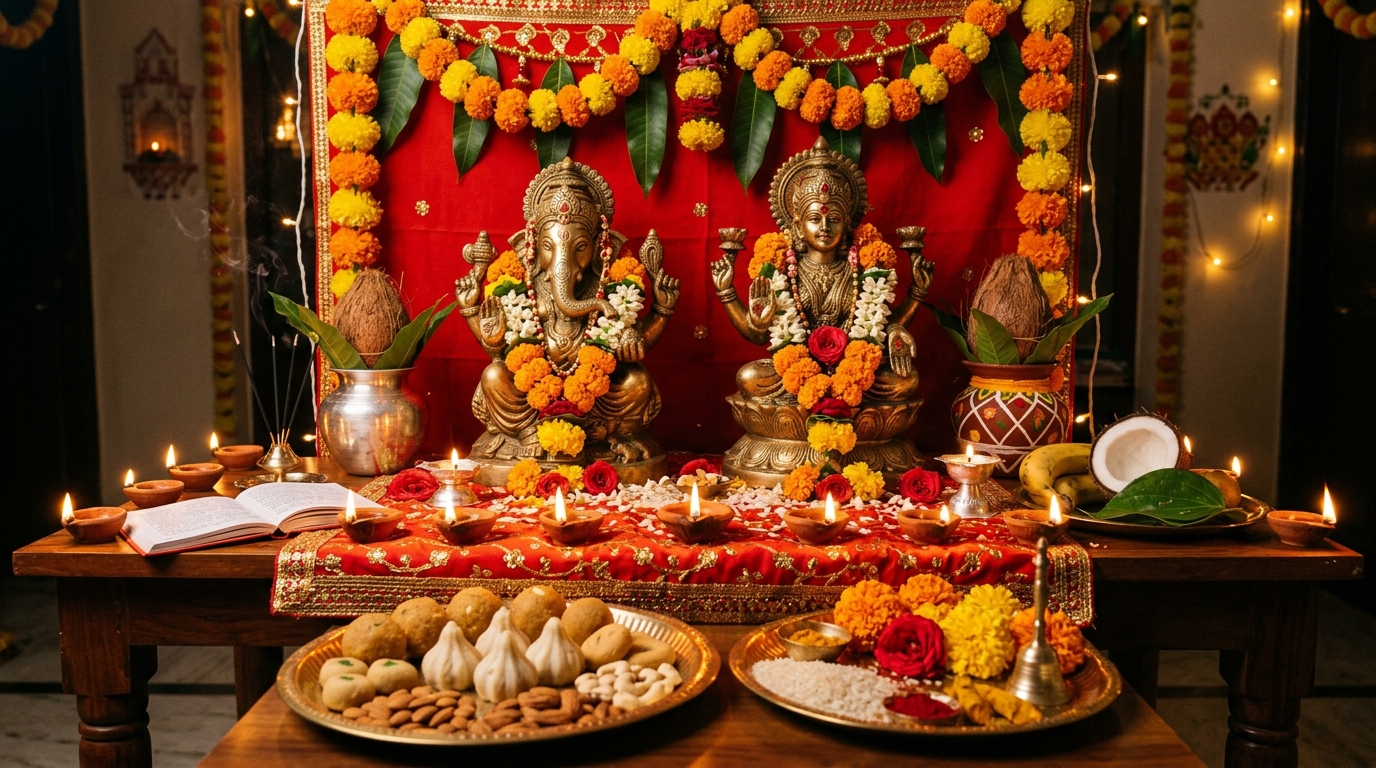
Laxmi Pujan 2026 Date & Auspicious Timings
In 2026, Diwali Lakshmi Pujan will be celebrated on Sunday, November 8, 2026, with the most auspicious puja timing falling during Vrishabha Sthir Lagna from 06:15 PM to 08:00 PM (IST). This 1-hour and 45-minute window falls within the broader Pradosh Kaal window (05:30 PM to 08:07 PM). Performing the ritual during a fixed ascendant (Sthir Lagna) like Vrishabha is highly recommended as it is believed to help Goddess Lakshmi’s blessings reside permanently in your house and business.
Explore November Calendar: Since Lakshmi Pujan falls in November, check the full Kalnirnay November 2026 Calendar to view all other festival dates, bank holidays, and planetary transits.
- Pradosh Kaal Muhurat: 05:30 PM to 08:07 PM
- Vrishabha Sthir Lagna (Best for home & business): 06:15 PM to 08:00 PM
Lakshmi Pujan Samagri Checklist (सामग्री सूची)
To perform a complete and auspicious Diwali Lakshmi Puja, you require essential elements like idols of Goddess Lakshmi and Lord Ganesha, raw rice grains, puffed rice (lahya), and a copper Kalash. Having these sacred items ready before the Vrishabha Sthir Lagna starts ensures an uninterrupted and peaceful ritual. Below is the complete checklist of traditional puja samagri with their spiritual significance:
| Item Name (English) | Hindi / Traditional Term | Significance |
|---|---|---|
| Ganesha & Lakshmi Idols | श्री गणेश और लक्ष्मी माता की मूर्ति | Ganesha is the remover of obstacles; Lakshmi represents wealth. |
| Red/Yellow Silk Cloth | लाल या पीला रेशमी कपड़ा | For laying on the wooden platform (Chowki). |
| Copper Kalash | तांबे का कलश | Symbol of the universe filled with divine water. |
| Coconut | नारियल (श्रीफल) | Offered on top of the Kalash. |
| Mango Leaves | आम के पत्ते | Used to decorate the Kalash neck. |
| Coriander Seeds | साबुत धनिया के बीज | Signifies financial growth and wealth multiplication. |
| Puffed Rice & Batashe | खेल-खिलौने (लाह्या) और बताशे | Traditional sweet offerings of the harvest season. |
| Betel Nuts & Leaves | सुपारी और पान के पत्ते | Offered as symbol of devotion and respect (Tambula). |
| Turmeric & Vermilion | हल्दी और कुंकुम (रोली) | Auspcicious colors for drawing symbols and putting Tilak. |
| Clay Lamps & Ghee | मिट्टी के दीये और शुद्ध घी/तेल | To remove darkness and welcome light. |
| Gold/Silver Coin | सोने या चांदी का सिक्का | Offered to attract financial abundance. |
Step-by-Step Puja Procedure (सरल पूजा विधि)
The simple Diwali Lakshmi Puja procedure involves purifying your house, placing the deities (with Ganesha on Lakshmi’s left), establishing the Kalash, and offering Naivedya snana. By following nine structured steps, you can perform this sacred ritual yourself at home to welcome prosperity and abundance. Here is the step-by-step puja guide:
- Step 1: Clean and Purify: Clean the house and spray Ganges water (गंगा जल) or pure water throughout the rooms to cleanse the atmosphere. Draw a Rangoli at the entrance.
- Step 2: Prepare the Platform: Set up a wooden platform (Chowki) in your puja room or living area. Spread a fresh red silk cloth over it. Spread some grains of raw rice in the center.
- Step 3: Setup Ganesha & Lakshmi: Place the Ganesha idol and Lakshmi idol side by side. Ganesha must be placed on the left side of Lakshmi, as Ganesha is the elder brother/guide who clears paths first. Place your gold, silver coins, and ledger books/wallets nearby.
- Step 4: Establish the Kalash: Take the Kalash, fill it 3/4th with clean water. Put a coin, betel nut, and raw rice inside. Place 5 mango leaves around the neck of the Kalash, and top it with a coconut. Place this Kalash in the center of the rice grains.
- Step 5: Light the Lamps (Diya): Light a primary ghee lamp and place it on the right side of the platform. Light incense sticks. Light clay lamps around the platform.
- Step 6: Perform Abhishek & Tilak: Offer water to bathe the idols symbolically. Apply haldi-kumkum (Tilak) to the foreheads of Ganesha, Lakshmi, the Kalash, and the gold/silver coins. Offer flowers (specifically red roses or lotuses).
- Step 7: Offering Naivedya: Offer Puffed Rice (Lahya), Batashe, coriander seeds, dry fruits, and sweets. Pour Panchamrit (a mixture of milk, curd, honey, ghee, sugar) as an offering.
- Step 8: Chant Mantras: Sit calmly, close your eyes, and chant the Lakshmi and Ganesha mantras (see below).
- Step 9: Perform Aarti: Perform the Ganesha Aarti (*Jai Ganesh Jai Ganesh Deva*) followed by the Lakshmi Aarti (*Om Jai Lakshmi Mata*). Wave the camphor (kapur) lamp. Offer flowers of surrender (Pushpanjali) and pray for the welfare of the family.
What Most People Get Wrong About Diwali Lakshmi Pujan
Many households unknowingly make errors during Diwali Lakshmi Puja by misplacing Ganesha’s idol, sweeping the house after puja, or shutting doors completely. Correcting these habits invites genuine abundance and aligns the ritual with traditional scriptures. Here are the key misconceptions corrected by practitioner insights:
- Position of Lord Ganesha: A very common error is placing Ganesha on the right side of Lakshmi. According to scriptures, Ganesha is the path-maker who must be placed on Lakshmi’s left side (representing the direction of wisdom leading wealth).
- Sweeping Immediately After Puja: Worshippers often sweep the puja room or clean up the house as soon as the puja concludes. Traditional Maharashtrian and Vedic rules strictly forbid sweeping at night or immediately after Lakshmi Pujan, as it is symbolically associated with driving away the goddess (Alakshmi).
- Locking the Main Entrance Door: Keeping the house completely closed to keep out cold air or noise is a mistake. During the Muhurat window, keep your main door or a window slightly open, and light a clay lamp near it to welcome Goddess Lakshmi.
- Using Plaster of Paris (PoP) Idols: Avoid buying PoP idols. Choose eco-friendly Shadu clay or brass/silver idols. Clay represents the Earth element, which retains the spiritual energy of your chants.
Situational Decision Framework for Lakshmi Puja
Depending on whether you are performing the puja in your home, at a business office, or during travel, your setup and timing will vary. Use the framework below to determine the best actions and outcomes for your specific situation:
| If Your Situation Is… | The Recommended Action Is… | The Spiritual & Practical Outcome Is… |
|---|---|---|
| You are performing puja at a business office or shop. | Perform puja during the late evening or check the night Nishita Kaal window. Focus offerings on ledgers (Bahi-khata), computers, cash boxes, and gold coins. | Invokes commercial success, prosperity, and financial stability for the business in the upcoming financial year. |
| You missed the Vrishabha Sthir Lagna window (06:15 PM – 08:00 PM). | Do not panic. You can perform the puja during the remaining Pradosh Kaal window before 08:07 PM, or wait for the midnight Nishita Kaal window. | The worship remains valid and auspicious, avoiding the negative impacts of arbitrary timings. |
| You are staying in a rented home or traveling during Diwali. | Set up a simple altar with a print or small photo of Ganesha and Lakshmi. Perform a mental puja (Manasa Puja) or offer a gold/silver coin on rice. | Maintains the continuity of your annual worship without requiring heavy idols or complex materials. |
Key Vedic Terms & Meanings in Lakshmi Pujan
To connect deeper with the ritual, it is essential to understand terms like Pradosh Kaal, Sthir Lagna, and Coriander Seeds. These components are rich in cosmic meaning and define the quality of the puja. Below are their semantic definitions and roles:
- Pradosh Kaal: The period of approximately 2 hours and 24 minutes after sunset. It is believed that during this time, planetary energies are peaceful and receptive, making it the most auspicious time for family worship.
- Vrishabha Sthir Lagna: A specific astrological ascendant represented by the bull (Vrishabha), which is a fixed (Sthir) sign. Astrologers recommend this lagna because it symbolizes stability, ensuring that wealth remains stable in your household.
- Coriander Seeds (Dhaniya): Offering whole coriander seeds is a unique Diwali tradition. In Vedic symbology, coriander seeds are considered a symbol of wealth multiplication and are kept in the safe after the puja.
- Lahya (Puffed Rice) & Batashas: Puffed rice represents the freshly harvested autumn crop offered to the gods in gratitude, while sugar batashas represent sweetness, representing a sweet and peaceful household.
Auspicious Lakshmi & Ganesh Mantras
The key mantras for Diwali Lakshmi Puja include the Ganesh Shloka to clear obstacles, the Lakshmi Gayatri for wisdom, and the Maha Lakshmi Mantra to attract abundance. Chanting these Sanskrit verses with focused devotion attracts positive monetary and spiritual energy. Below are the essential mantras in Devanagari script, English transliterations, and meanings:
वक्रतुण्ड महाकाय सूर्यकोटि समप्रभ।
निर्विघ्नं कुरु मे देव सर्वकार्येषु सर्वदा॥
“Vakratunda Mahakaya Suryakoti Samaprabha,
Nirvighnam Kuru Me Deva Sarvakaryeshu Sarvada.”
Meaning: O Lord with a curved trunk and massive body, who shines with the luster of a million suns, please make all my endeavors free from obstacles at all times.
ॐ महालक्ष्म्यै च विद्महे विष्णुपत्न्यै च धीमहि।
तन्नो लक्ष्मी प्रचोदयात॥
“Om Mahalakshmyai Cha Vidmahe Vishnupatnyai Cha Dhimahi,
Tanno Lakshmi Prachodayat.”
Meaning: We meditate on the supreme Goddess Mahalakshmi, the consort of Lord Vishnu. May that Goddess of wealth and prosperity inspire and guide our intellect.
ॐ श्रीं ह्रीं क्लीं त्रिभुवन महालक्ष्म्यै अस्माक दारिद्र्य नाशय प्रचुर धन देहि देहि नमः।
“Om Shreem Hreem Kleem Tribhuvana Mahalakshmyai Asmaka Daridrya Nashaya Prachura Dhana Dehi Dehi Namah.”
Meaning: Salutations to the Goddess of the three worlds who destroys poverty. Please bless us with abundant wealth, prosperity, and spiritual growth.
Diwali Laxmi Pujan 2026 FAQs
Find answers to the most frequently asked questions about Lakshmi Pooja dates, Sthir Lagna, and traditional puja procedures.
Diwali Laxmi Pujan (Lakshmi Puja) in 2026 will be celebrated on Sunday, November 8, 2026, corresponding to Ashwin Amavasya according to the Shalivahana Shaka calendar. This is the main day of Diwali festival celebrations across Maharashtra.
The most auspicious timing to perform the puja is during the Vrishabha Sthir Lagna (06:15 PM to 08:00 PM) on Sunday, November 8, 2026. This period falls within the broader Pradosh Kaal window which runs from 05:30 PM to 08:07 PM.
Vrishabha is a fixed astrological sign (Sthir Lagna). Performing Lakshmi Pooja during a Sthir Lagna is highly recommended because it is believed to help Goddess Lakshmi’s blessings and financial prosperity reside permanently (sthir) in your home or shop.
Coriander seeds (Dhaniya) are symbolically associated with wealth multiplication and financial expansion in Vedic traditions. They are offered during the Laxmi Pooja and later stored inside your cash locker or locker room to attract cash flow and good fortune.